




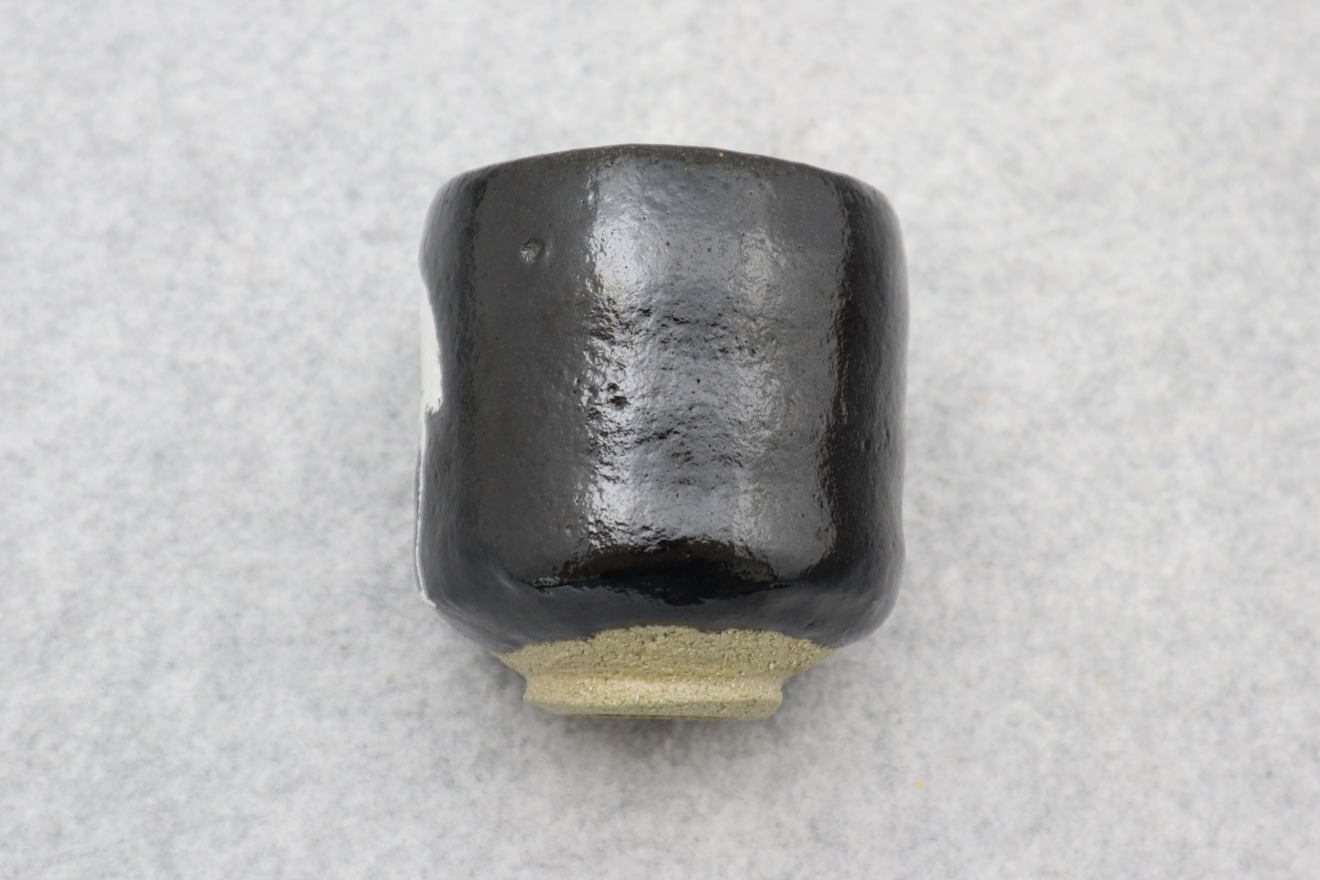
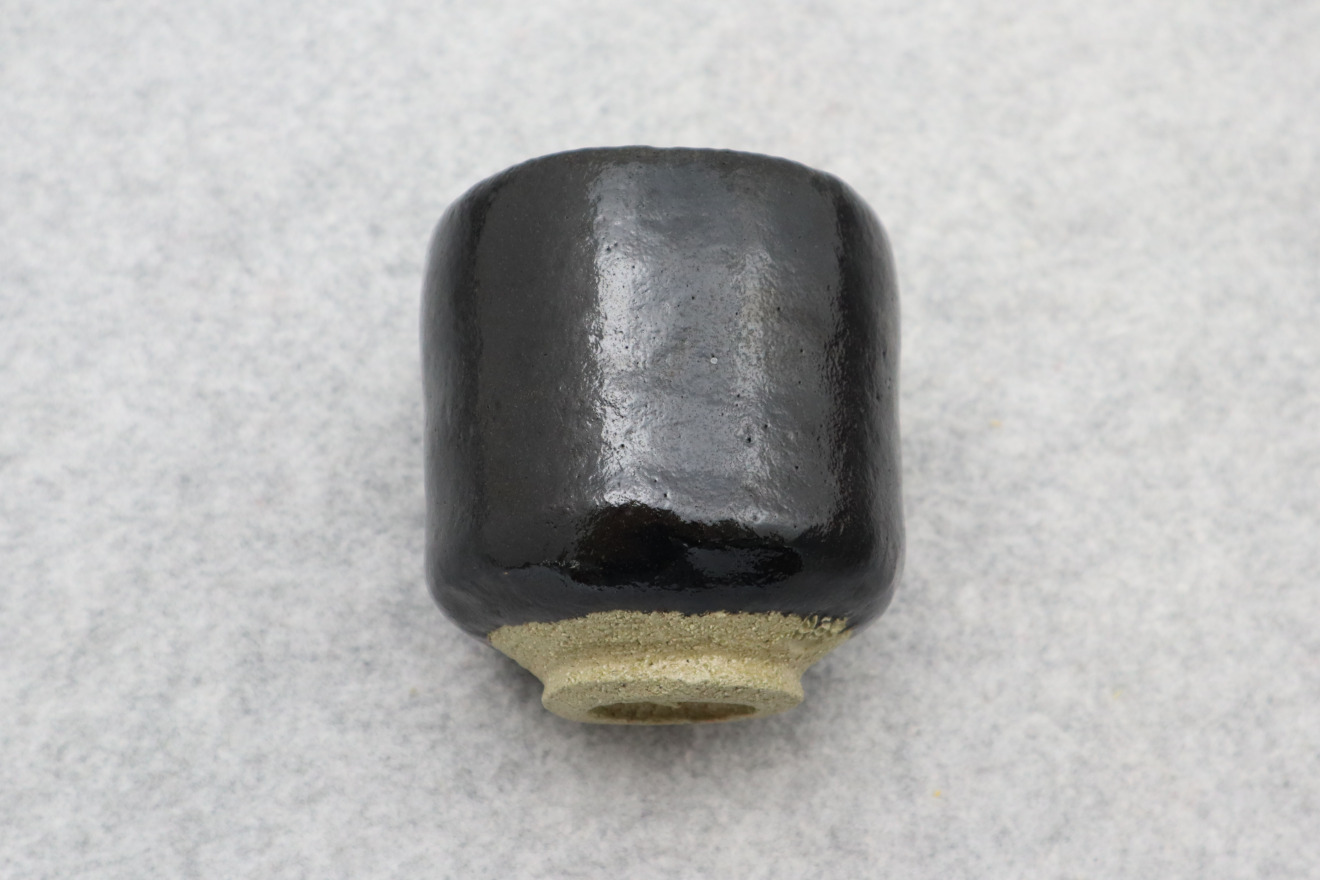

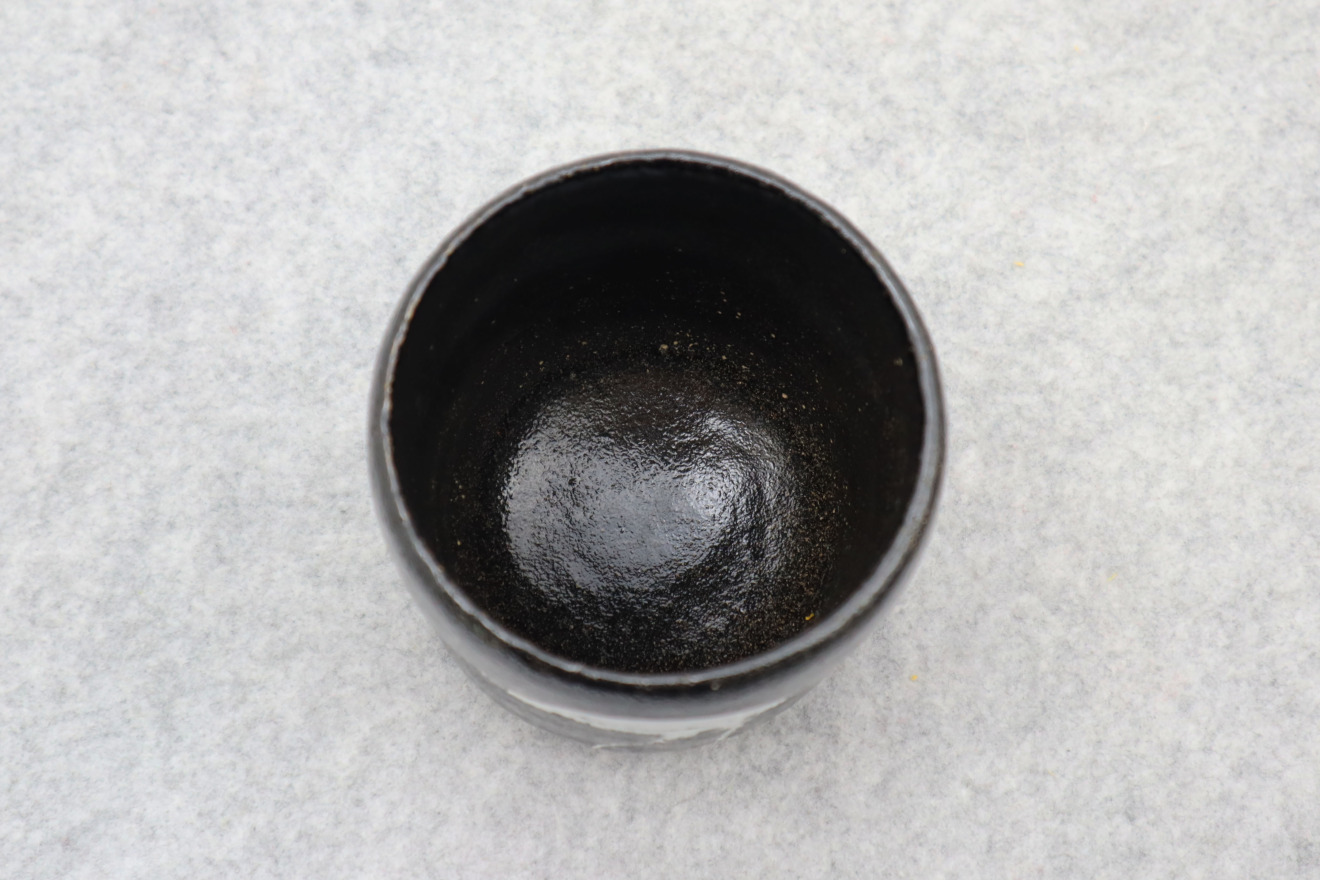
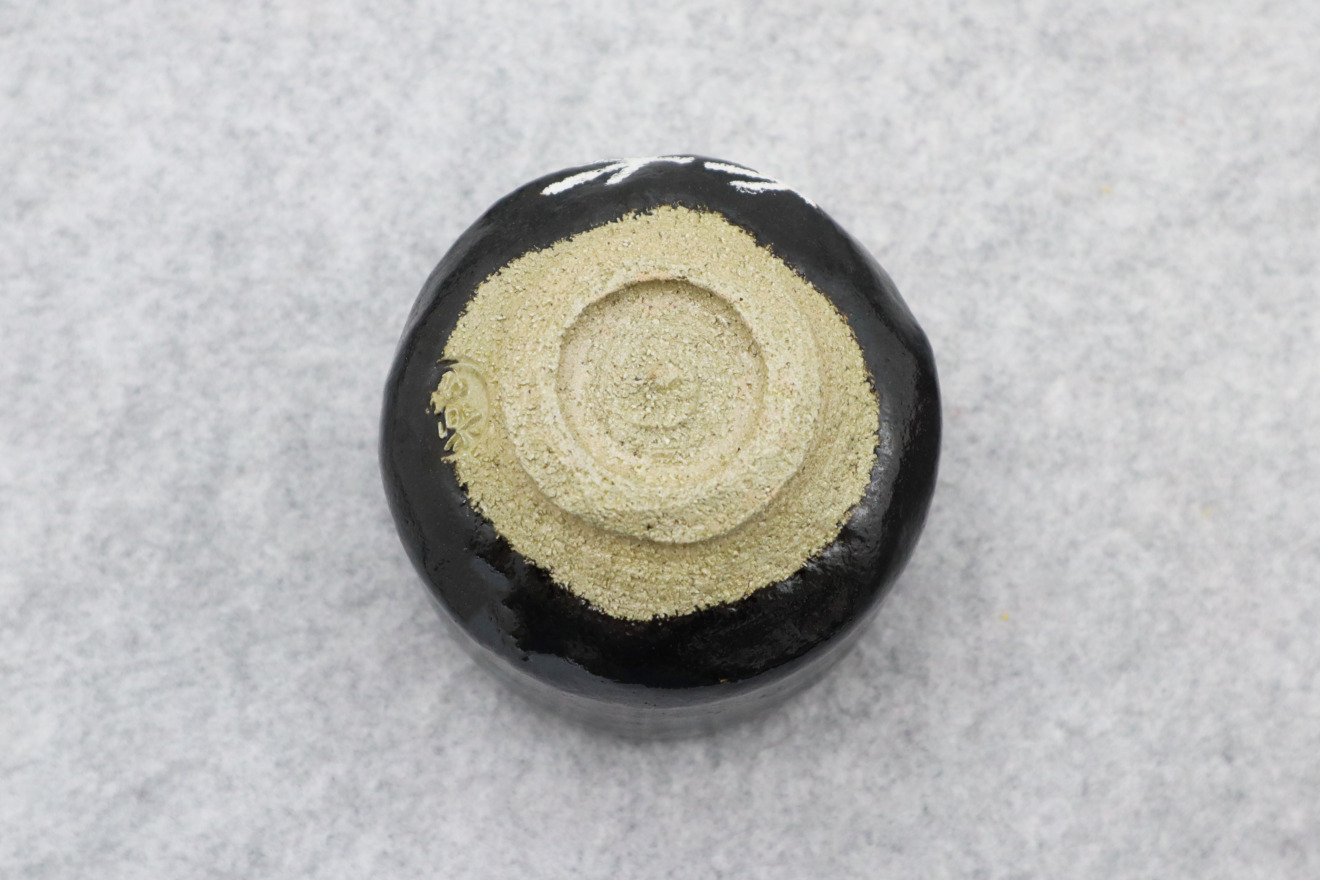


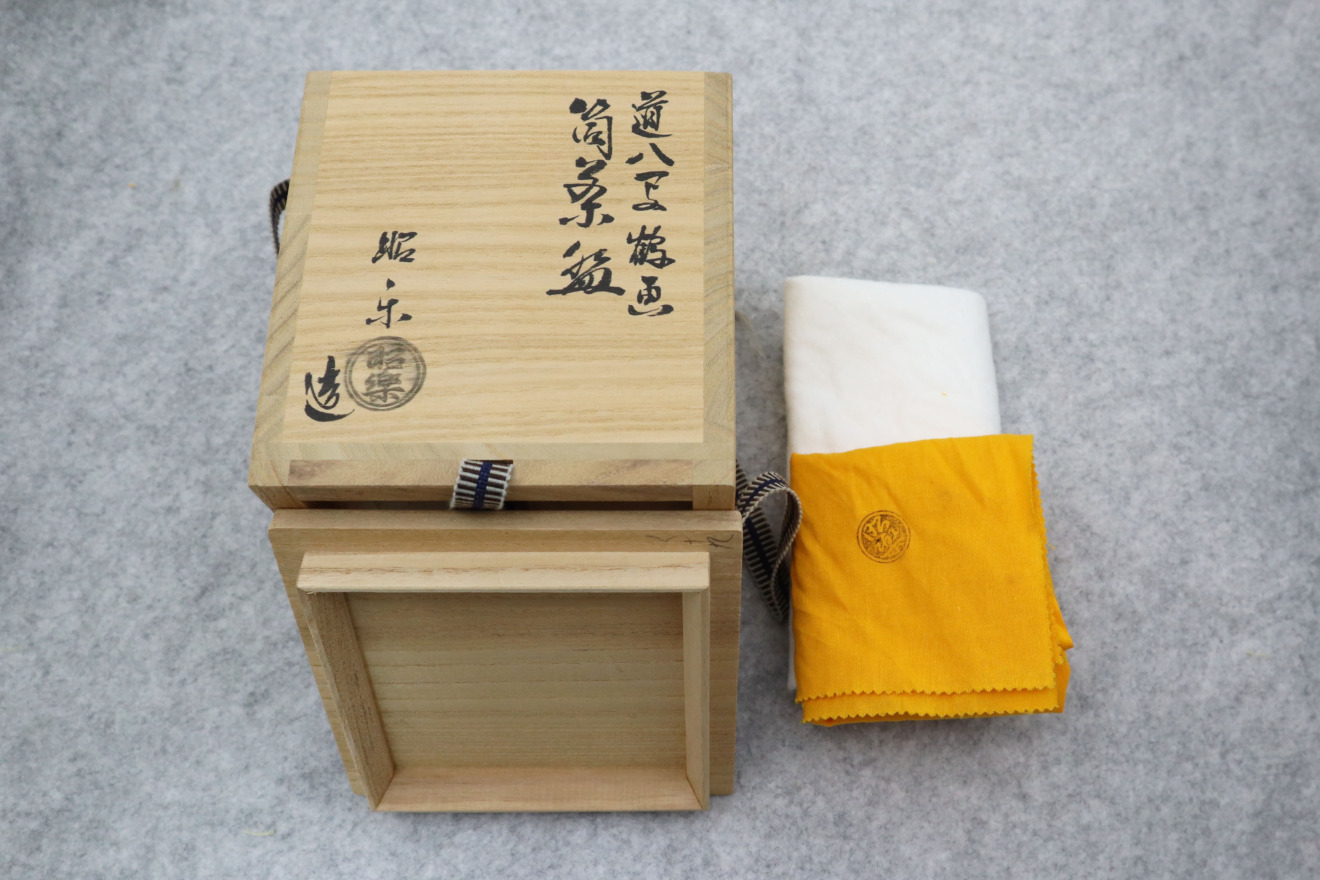
Vintage Black Raku Mei Matcha Tea Bowl, 3rd Sasaki Shoraku, Name (Mei): Tsuruga, Dōhachi Utsushi, Reproduction, Matcha Tea Bowl, Kuro Raku Tsutsu Chawan, Winter Tea Bowl, Unused,
MB-080901
Raku ware is a type of pottery ware produced in Kyoto.
Raku ware refers to ceramics, mostly tea bowls, produced by the Raku family from the first generation Chojiro. Raku ware is formed by hand, and fired in temperatures from 700℃ to 1,000℃.
There are two type of Raku ware: the Aka-raku (Red Raku ware), which is covered with transparent glaze over a clay surface containing iron oxide, and Kuro-raku (Black Raku ware), which is covered with black glaze. The term “Raku” sometimes refers to all pottery ware made by this same process. – Quote from A Dictionary of Japanese Art Terms
3rd Sasaki Shoraku born in Kyoto in 1944. His mentor is 2nd Shoraku. He succeeded to 3rd Shoraku in 1962.
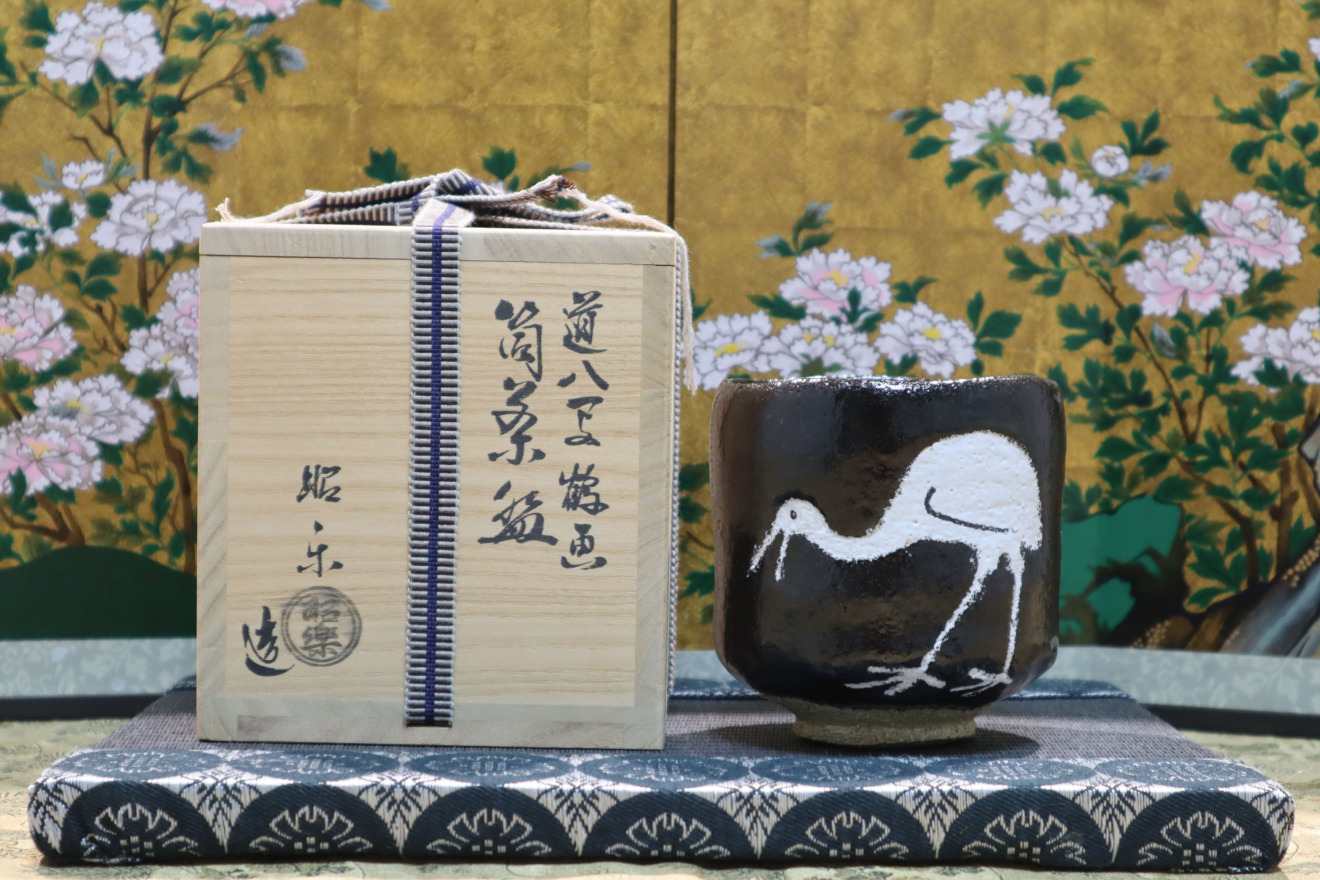
We got it from our friend. It is still in excellent condition with original paulownia box and original cloths. (Unused).
According to our friend, her family did not use the tea bowl.
The product shows no signs of use.
The Black Raku Tsutsu Tea Bowl was made by 3rd Sasaki Shoraku born in Kyoto in 1944. His mentor is 2nd Shoraku. He succeeded to 3rd Shoraku in 1962.
Originally the name of tea bowl was made by Nin’Ami Dōhachi.
Nin’Ami Dōhachi (1783-1855, the second-generation Takahashi Dōhachi) was one of the leading potters of “Kyo-yaki” and “Oniwa-yaki” from the mid to late Edo period. With his keen aesthetic judgment and exceptional technical skill, he gained renown as a genius potter. Historical sources suggest that he supplied works not only to feudal lords, wealthy merchants, and temples around Kyoto, but also to patrons throughout Japan.
Born in 1783 as the second son of the first-generation Takahashi Dōhachi, a potter of Kyoto’s Awataguchi district, his given name was Mitsutoki. In addition to studying under his father, he is said to have apprenticed with Hōzan Bunzō, the 11th head of the long-established Unrin’in Hōzan family of Awataguchi ware, as well as Okuda Eisen, known for his works in the style of Chinese ceramics.
In 1804, upon the death of his father, he inherited the family kiln and assumed the name of the second-generation Dōhachi. In 1811, he relocated the kiln from Awataguchi to Gojōzaka, where he later worked alongside the third-generation Dōhachi. In 1826, at the age of 44, he received the titles “Hokkyo 法橋” and the character “Nin 仁” (or “Nin’a 仁阿”) from the Imperial Prince of Ninnaji, and the character “Ami 阿弥” from the Imperial Prince of Daigoji’s Sanbō-in. Combining these, he began using the art name “Nin’Ami 仁阿弥”.
Late Edo Kyoto is often described as the “second golden age” of ceramics, following that of Nonomura Ninsei, and Dōhachi was one of its representative masters. In 1842, he retired after handing over the kiln to the third generation, established the “Momoyama Kiln” in Fushimi-Momoyama, and continued producing works until his death in 1855 at the age of 73.
Nin’Ami Dōhachi frequently incorporated auspicious Zen motifs into his works. His famous “Black Raku Tea Bowl with Crane and Tortoise Design” (Tokyo National Museum) features a white-outlined crane on the exterior and a leisurely walking tortoise depicted inside the bowl. Cranes and tortoises are traditional symbols of longevity, and such motifs were favored by Dōhachi, who was influenced by late-Edo literati potters such as Okuda Eisen, as well as by Ninsei and Kenzan.
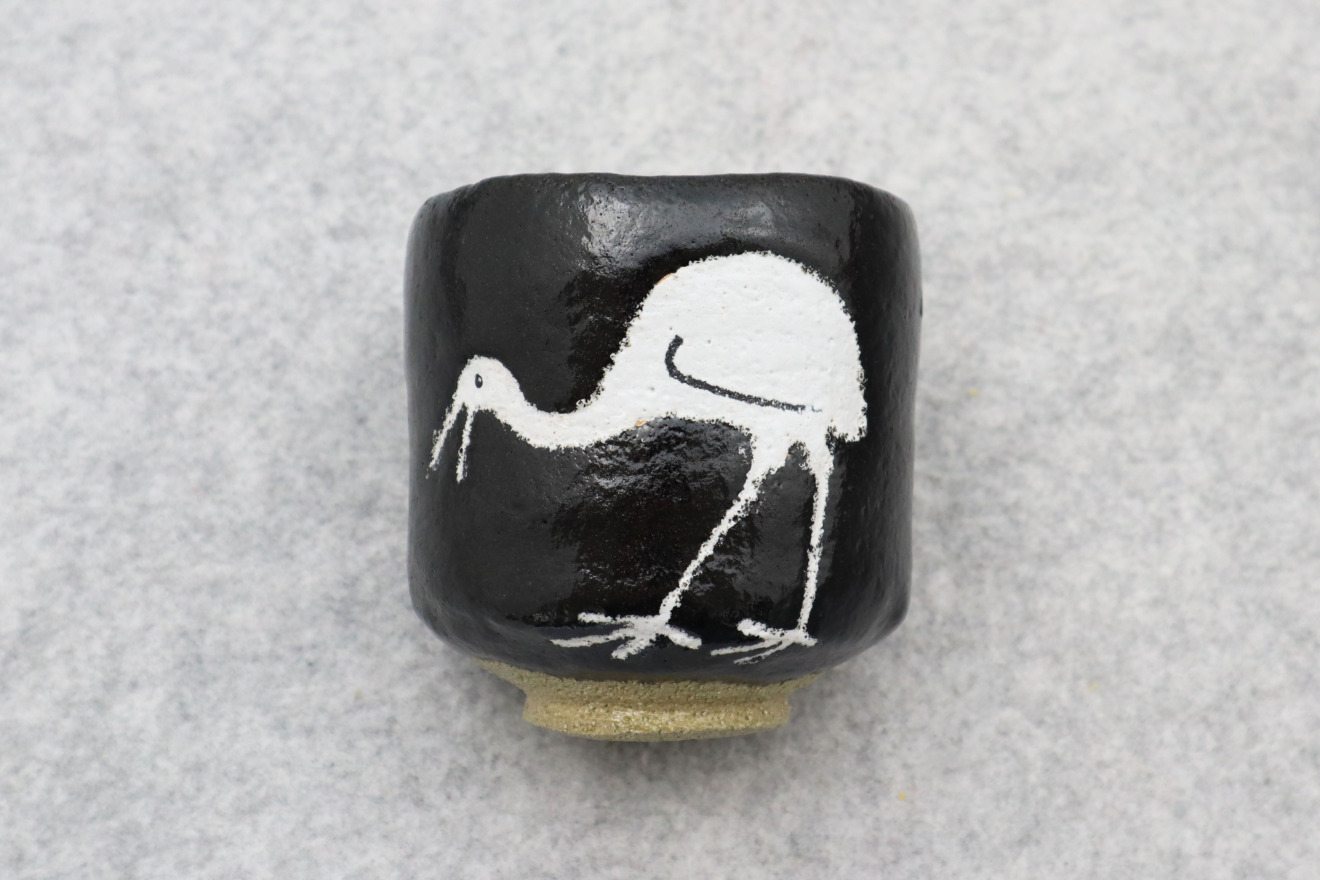
The bowl in the photograph – an interpretation by Sasaki Shōraku – features only the crane on its exterior, with no tortoise painted inside the well of the bowl. Accordingly, its inscription reads “Dōhachi Reproduction: Crane Design.”
We got it from our friend. It is still in excellent condition with original paulownia box and original clothes. (Unused).
According to our friend, her family did not use the tea bowl.
We do not see any sign of using it, too.
Measurement
Diameter: 9cm / Approx. 3 35/64”
Tall: 10.1cm / Approx. 3 31/64″
Thickness: 0.6cm / Approx. 0 15/64”
Weight: 322g
Age: -2010s
Material: Earthenware, Pottery
Color: Black Raku, White
Technique: Black Raku
Title: Dōhachi Utsushi, Mei: Tsuruga, Tsutsu Chawan
Condition: Excellent vintage condition consistent with age. (Unused)
* Original paulownia box (Shihousan, wood nails)
* Original cloths
* No chips, no cracks, no scratches and no blemishes.
* Raku pimples on the surface
* Inscription (Refer to No. 8 Photo)
* Almost no discoloration on the box. (Refer to No. 10 Photo)
* Price tag was peeled off from the paper box. (Refer to No. 10 Photo)
* Minor discoloration on the cloth. (Refer to No. 10 Photo)
* No strange smell.
* You may find “minor scratch” on kodai (the base section of a tea bowl).
*** If you have any questions about the condition or would like additional photos, please contact us before purchasing. ***


