




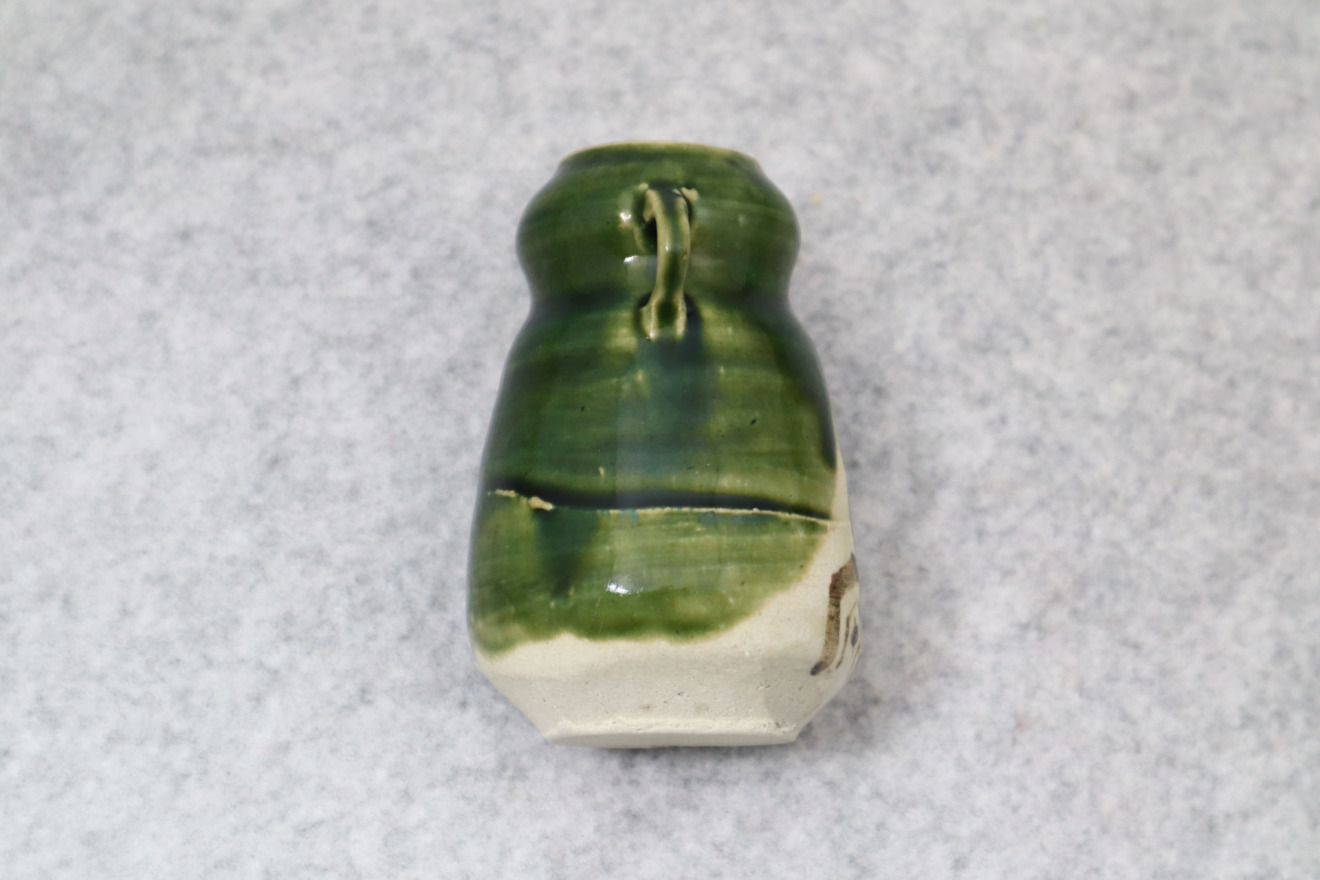

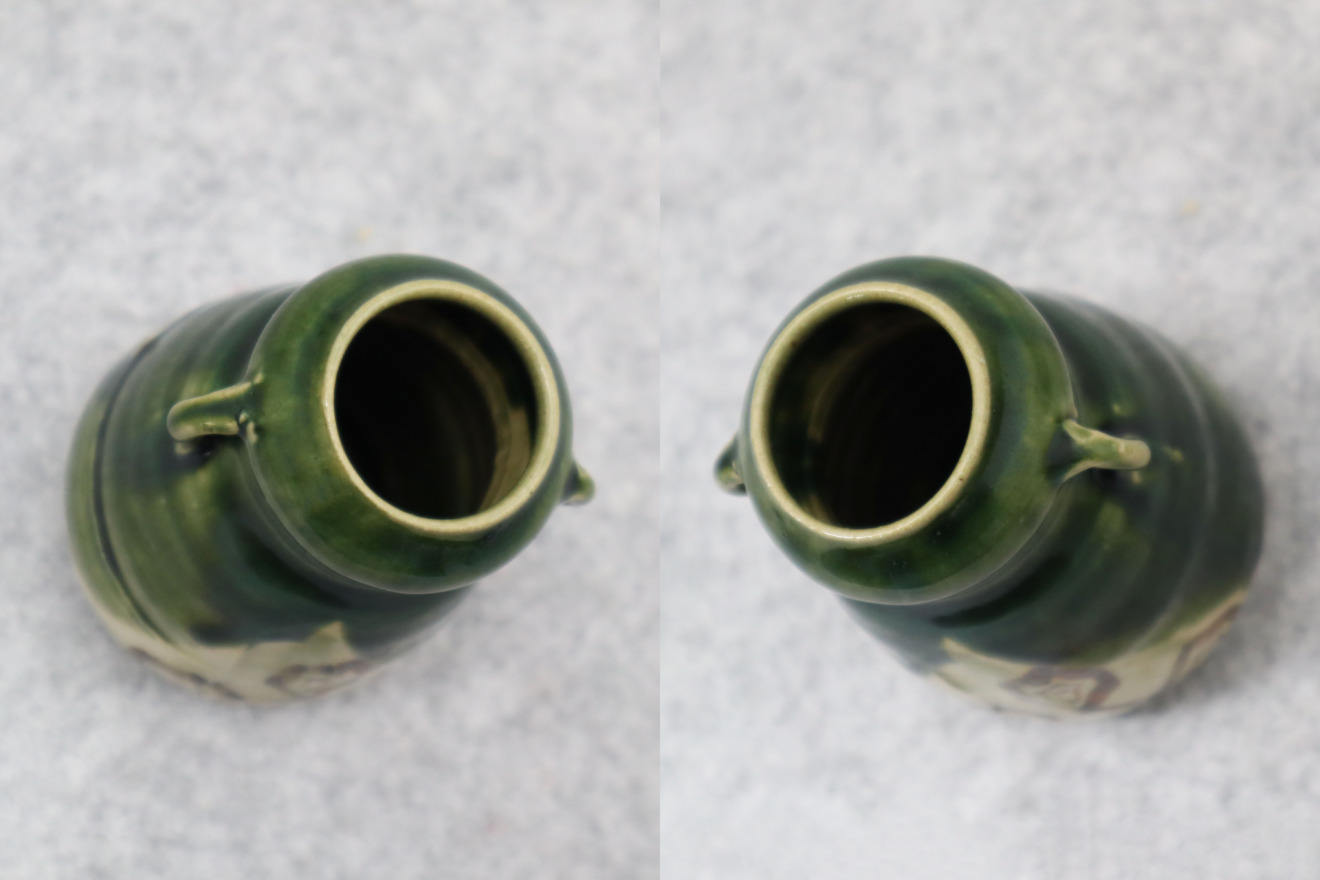


Vintage Oribe Chaire Tea Caddy, Kawamoto Ryosho, Mimitsuki Chaire, Oribe ware, Unused,
MC-031201
Oribe ware is a type of Mino ware and usually glazed in Strong Olive Green and Deep Olive Green. It was developed by Lord Furuta Oribe, a disciple of Sen no Rikyu.
Kawamoto Ryosho (1948–2004)
1948 Born in Shimane Prefecture
1978 After training at the Aichi Prefectural Ceramic Training School, studied under Hayashi Hidehito
1982 Built the Sangetsu Kiln in Okute-chō, Mizunami City
1990 Constructed an “anagama” (wood-fired tunnel kiln) with the aim of reproducing early ceramic works
Member of the Mizunami Ceramic Art Association
January 2004 Passed away at the age of 55
**About Mimitsuki Chaire (Tea Caddies with Ears)**
The *Chaki Bengyoku-shū*, a compendium of tea utensils published in the Edo period, includes at its end tea caddies thought to have been produced later than Seto tea caddies.
Among these are Oribe tea caddies, and the text highlights the “tea caddy with ears” as the foremost characteristic feature of Oribe tea caddies.
For people of that time, a tea caddy with ears was considered highly unconventional—a vessel embodying Furuta Oribe’s aesthetic sensibility, known as “mono-suki” (a love of unusual objects). These caddies were regarded as superb pieces, costly, and produced only in very limited numbers.
Even today, the Oribe tea caddy with ears is considered the most iconic form among Oribe tea caddies. The Narumi Oribe Kiln Tea Caddy with Ears, known by the name “Gakibara” (Starving Demon’s Belly), in the collection of the Nomura Museum of Art in Kyoto, is celebrated as a distinguished “chūkō meibutsu” (a later-generation masterpiece).
**About the Lid of the Tea Caddy**
The lid of this tea caddy has black streaks.
These streaks are referred to as “su” (nest) or sometimes “mushikui” (worm-eaten), although they are neither caused by insects nor actual holes. Because these black marks resemble “nests,” such lids are called “subuta” (nest lids).
Sen no Rikyū regarded these black streaks as flaws and is said to have positioned the tea caddy with the “su” on the “katte-tsuke” side (to the host’s left, farther from the guest).
In contrast, his disciple Furuta Oribe viewed the marks as “scenery” and placed them on the “kyaku-tsuke” side (to the host’s right, nearer to the guest), so that they would be visible.
It is said that Rikyū was deeply impressed by Oribe’s aesthetic preference.
Since this is an Oribe tea caddy, why not place the “su” on the right side (guest side) in appreciation of that tradition?
We got it from our friend.
According to our friend, her family did not use the tea caddy.
The product shows no signs of use.
Measurement
Opening Diameter: 2.9cm / Approx. 1 9/64”
Body: 6.0cm / Approx. 2 23/64”
Height without lid: 8.9cm / Approx. 3 1/2”
Height: 9.5cm / Approx. 3 47/64”
Weight (Incl the Lid): 144g
Age: 2000-2004
Material: Earthenware, Pottery
Lid: Original Lid
Shifuku: Silk
Color: Oribe Green, Oribe White, Oribe Brown
Shape: Mimitsuki Chaire (Tea Caddies with Ears)
Shifuku pattern: Tsurugaoka Kanto
Shifuku cord: Normal length
Condition: Excellent vintage condition consistent with age (Unused)
* Original paulownia box
* Original paper box
* Original lid
* Original shifuku.
* Shifuku paper
* Cloth for protection
* Wood nails on the box.
* No chips, no cracks, no scratches and no blemishes.
* Kannyu on the surface
* Inscription (Refer to No. 9 Photo)
* Almost no discoloration on the box. (Refer to No. 10 Photo)
* Witten shifuku name on the paper box. (Refer to No.10 Photo)
* You may find “minor scratch” on the bottom (the base section of a tea caddy).
*** If you have any questions about the condition or would like additional photos, please contact us before purchasing. ***


