

The Story of Donyuu (Nonko)
Donyuu (1599–1656), also known as Nonko, was the third-generation master of the Raku family and the eldest son of Jokei. He was known as Kichibei during his lifetime. His nickname, Nonko, is traditionally said to be connected to an inscription on a bamboo flower vase presented to him by the tea master Sen Sotan.
Raku tea bowls originated with Chojiro, who worked closely with Sen no Rikyu. Donyuu continued this tradition while introducing a new sense of movement, lightness, and individuality into Raku ware. He also had a close relationship with Hon’ami Koetsu, whose artistic approach is thought to have influenced his work.
Donyuu’s tea bowls are often characterized by their thin construction, generous rounded forms, and expressive use of glaze. His black Raku bowls, in particular, are admired for their lustrous black surfaces and decorative glazing techniques.
Among these techniques are maku-gusuri (幕釉), in which layers of black glaze flow down the surface like a curtain, and kihage (黄ハゲ), in which black glaze is deliberately omitted from certain areas and a yellowish glaze is applied instead.
These innovations brought a distinctive decorative quality to Raku tea bowls and influenced later generations. The kihage technique was also employed by the eleventh-generation master Keinyu (1817–1902) and the twelfth-generation master Konyu (1857–1932).
Aoyama – One of the Nonko Kaga Shichishu
The black Raku tea bowl “Aoyama” is one of the celebrated Nonko Kaga Shichishu, a group of seven tea bowls by Donyuu that were formerly associated with the Kaga region.
The bowl takes its name from Aoyama Shogen, a chief retainer of the Maeda clan of Kaga, who once owned it.
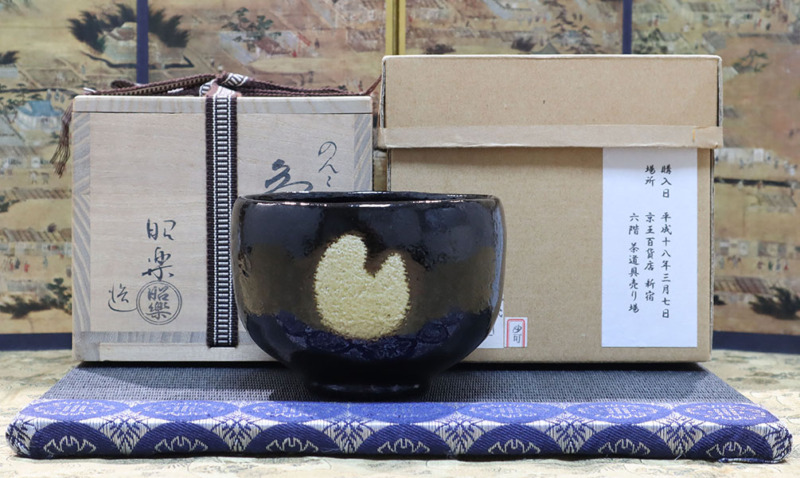
The original Aoyama has a thinly pared rim known as hamaguriba (蛤端), a generously rounded body, and a boldly carved, nearly circular foot ring. Its lustrous black glaze is interrupted by a pale yellowish area created using the kihage technique, forming a pattern reminiscent of a waterbird.
The original Aoyama is now held by the Raku Museum in Kyoto and was designated an Important Cultural Property of Japan in 2016.
The photograph shows a reproduction of Aoyama made by third-generation Sasaki Shoraku (born 1944), a Kyoto Raku-ware potter.