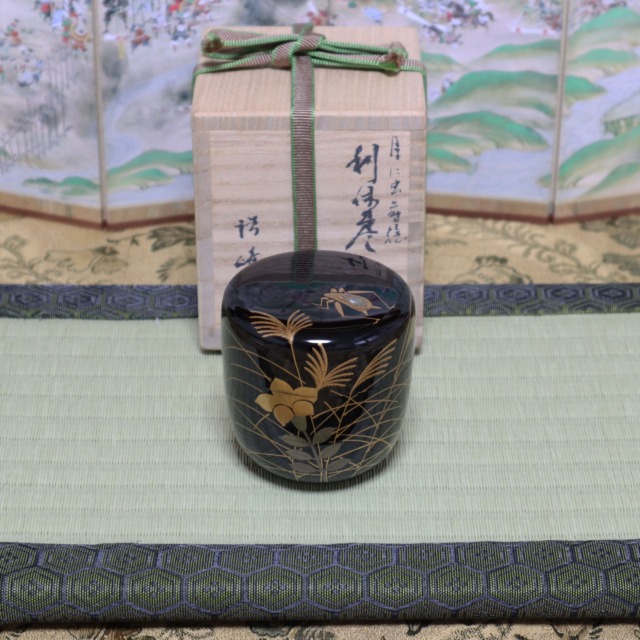


Vintage Kyo Chaire, Tea Caddy, Sasada Hitoshi, Hatakeyama Katatsuki Utsushi, Katatsuki Chaire, Unused,
Sasada Hitoshi / Also known as Sasada Yushō
Born in Kyoto in 1952, Sasada Hitoshi is a ceramic artist known for tea ceramics, particularly reproductions of classical Karamono tea caddies.
Sasada pursued his early training in ceramics at the Ceramics Department of Hiyoshigaoka High School (Kyoto), graduating in 1970. He went on to complete his studies at the Kyoto Prefectural Ceramic Training School (1971) and the Ceramics Technician Training Program at the Kyoto Municipal Industrial Research Institute (1972). In 1973, he apprenticed under Tezuka Hisashi and studied tea ceramics.
In 1975, Sasada established his independent practice at the Gojozaka Cooperative Climbing Kiln, focusing on the creation of tea caddies modeled after historic masterpieces. Two years later, in 1977, he also adopted the artist name Yushō. His studio later moved to Umegadani, Higashiyama (1981), and in 1987 he established a permanent workshop in Nishigamo, Kyoto, following the closure of the Gojozaka kiln.
Sasada has continued to refine his craft over the decades, participating in kiln projects such as the climbing kiln in Mizuo Town, Tanba (1989), and ultimately establishing a new workshop in Nishigamo, Kitaku, Kyoto, in 1996. From this studio, he has continued to produce tea utensils based on traditional ceramic forms and techniques.
Form
Smaller in scale than most shoulder caddies, it is distinguished by the almost complete absence of a neck beneath the mouth and by its strongly projecting shoulders. From the waist downward, the vessel tapers sharply toward the base. The rough cord-cut foot (Tatami-Tsuke) adds a sense of solidity, while its substantial weight enhances its commanding presence in the hand.
Glaze and Surface
The body is covered with a rich, lustrous dark brown glaze, recalling the deep tones of Tenmoku tea bowls. Fine vertical streaks—known as Nogime kiln effects—appear across the surface, the result of iron crystallization during firing, imparting subtle variety to the glaze. Around the base, the glaze recedes to reveal a metallic golden clay body.
According to the inscription on its original signed box (Tomobako), this tea caddy by Sasada Hitoshi is a reproduction of the Hatakeyama Katatsuki.
The original Hatakeyama Katatsuki is a 15th-century Ko-Seto tea caddy in the collection of the Ebara Hatakeyama Museum.
It comes with its Tomobako (original signed paulownia box). The silk shifuku is also unused and remains in excellent vintage condition. There are no visible signs of use.
Measurement
Opening Diameter: 3cm / Approx. 1 3/16”
Body: 6.5cm / Approx. 2 9/16”
Height without lid: 7.9cm / Approx. 3 7/64”
Height: 8.5cm / Approx. 3 11/32”
Weight (including lid): 113g
Age: -2000s
Material: Pottery
Lid: Tomobuta, Original Lid
Shifuku: Silk
Color: Dark Brown, Brown, Black
Shape: Hatakeyama Katatsuki
Shifuku pattern: Hanairo Oshidori Komon Donsu
Shifuku cord: Normal length
Condition: Excellent vintage condition consistent with age. (Unused)
* Tomobako (original signed paulownia box)
* Original shifuku
* Artist-provided leaflet with information on the Hatakeyama Katatsuki Utsushi and the shifuku fabric pattern.
* Protective cloth
* No chips, cracks, scratches, or blemishes.
* Inscription (Refer to No. 9 photo)
* Almost no discoloration on the lid of the box. (Refer to No. 10 photo)
* The base of the piece comes into contact with surfaces, so minor contact marks may be present.
If you have any questions about the condition or would like additional photos, please contact us before purchasing.