




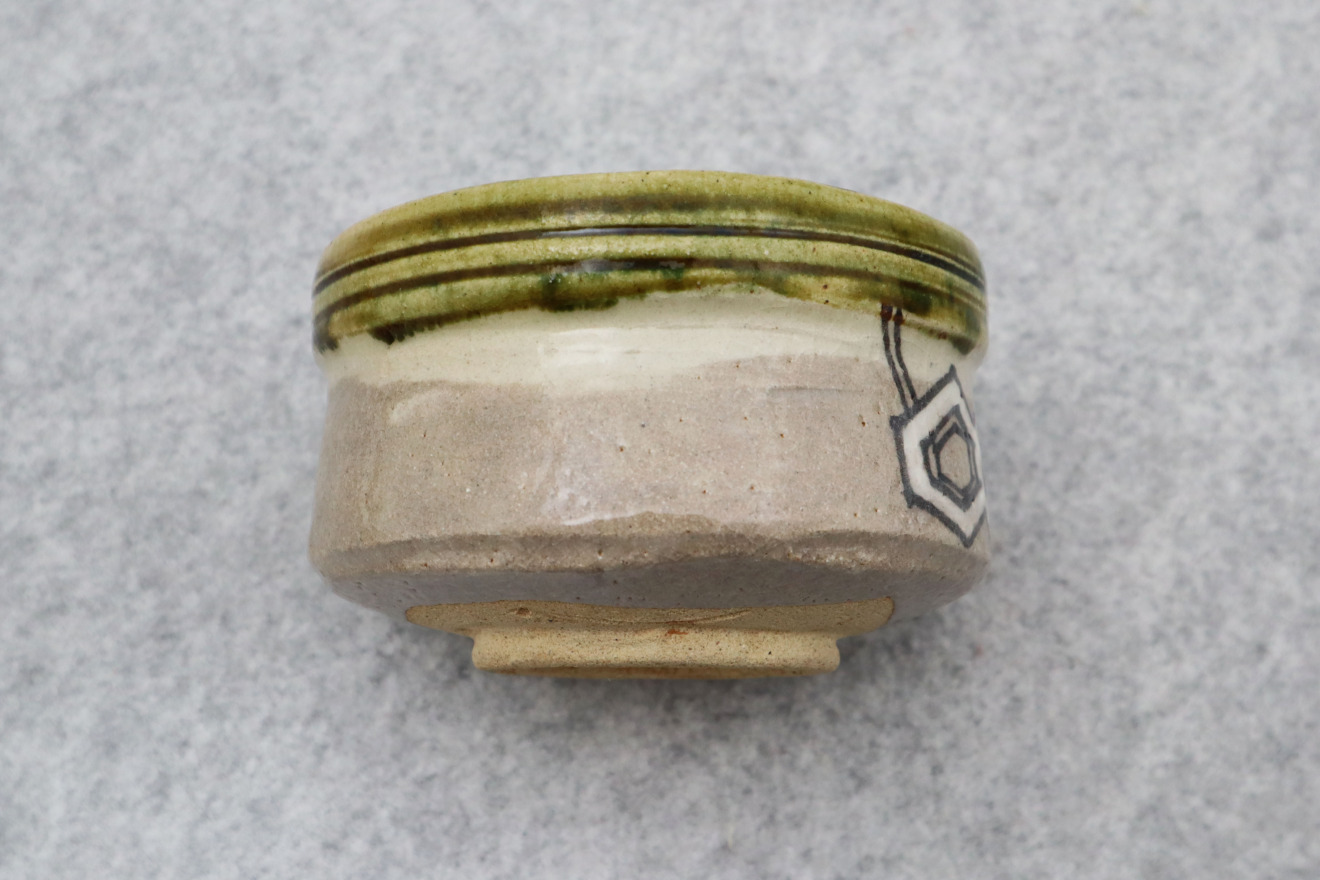


Vintage Narumi Oribe Matcha Tea Bowl, Hayashi Torao, Japanese Matcha Tea Bowl, Oribe Ware, Otozuka Kiln, Narumi Oribe, Chawan, Unused,
Oribe ware is produced in Toki City and the surrounding area of Gifu Prefecture. The origin of Oribe ware dates back to the end of the Momoyama period.
Oribe ware derives its name from the tea master Furuta Oribe (1544-1615) under whose guidance it was produced.
The characteristics of Oribe ware include black-glazed pieces known as Kuro Oribe (Black Oribe). – Quote from A Dictionary of Japanese Art Terms
This Narumi Oribe Matcha Tea Bowl was made by Hayashi Torao.
Hayashi Torao (1926-1998)
Biography
* Born in Gifu Prefecture in 1926 as the third son of Hayashi Kagemasa.
* His father, Kagemasa, was a potter designated as a Prefectural Important Intangible Cultural Property holder.
* In his youth, he worked for 18 years at a glass factory in Kasugai City, Aichi Prefecture.
* After leaving the glass factory, he studied pottery techniques under his father, Kagemasa, and began his career as a potter.
* Became the second head of the Otozuka Kiln.
Activities
* Selected for exhibitions such as the Japan Tea and Flower Utensil Art and Craft Exhibition.
* Active mainly through solo exhibitions.
* Member of the Mino Ceramic Art Association.
Style
* Creates works in traditional Mino ware styles such as Koseto and Oribe.
His father Hayashi Kagemasa (1891–1988: Founder of the Otozuka Kiln)
Biography
* Real name: Kenzō. Born in 1891.
* Born into a family engaged in pottery production. While working in the family business, he walked around nearby kiln sites, collecting and studying pottery fragments, and devoted himself to the revival of Mino ceramics from the Momoyama period (such as Ki-Seto, Shino, Oribe, and Setoguro).
* Established the Otozuka Kiln in 1935 in Kushiro, Izumi-cho, Toki City, Gifu Prefecture.
* Associated with figures such as Kitaōji Rosanjin.
* During the Shōwa period, he continued research on the revival of Mino ceramics, particularly Ki-Seto, and in 1958 (according to his son Torao, in 1957) was designated as a Gifu Prefectural Important Intangible Cultural Property holder for his work in Ki-Seto.
This tea bowl is unused and comes with its Tomobako (original signed paulownia box), Tomonuno (original artist-stamped cloth), and an artist-provided leaflet.
Hayashi Torao was a ceramic artist known for his Oribe and Shino ware.
Measurement
Diameter: 11.6cm – 12.3cm / Approx. 4 9/16” – 4 27/32”
Height: 7.0cm – 7.5cm / Approx. 2 3/4” – 2 61/64″
Thickness: 0.6cm – 0.7cm / Approx. 0 15/64” – 0 9/32”
Weight: 281g
Age: – 1998
Material: Pottery
Color: Oribe Black, Oribe Green, Oribe White Mud, Oribe Red Vanilla
Technique: Narumi Oribe
Title: Narumi Oribe
Condition: Excellent vintage condition consistent with age. (Unused)
* Tomobako (original signed paulownia box)
* Tomonuno (original artist-stamped cloth)
* Artist-provided leaflet
* No chips, cracks, scratches, or blemishes.
* Inscription (Refer to No. 9 photo)
* Wooden nails on the box.
* Almost no discoloration on the wooden box. (Refer to No. 10 photo)
* The kodai (foot ring at the base of the tea bowl) rests on surfaces, so minor contact marks may be present.
If you have any questions about the condition or would like additional photos, please contact us before purchasing.


