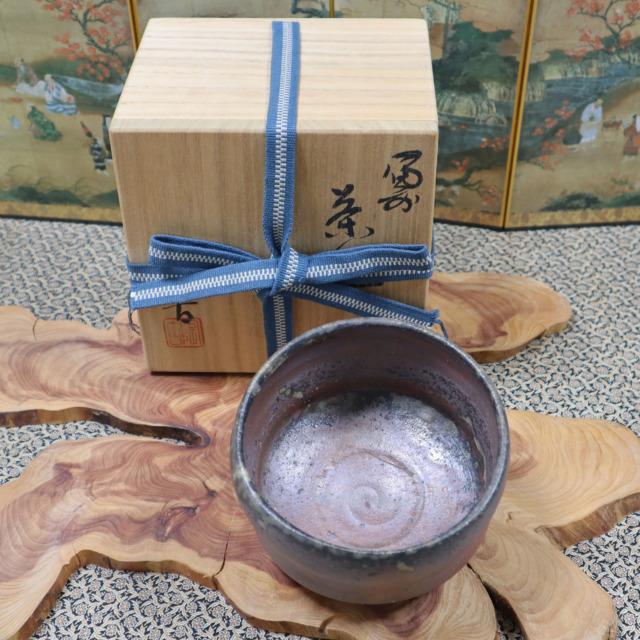


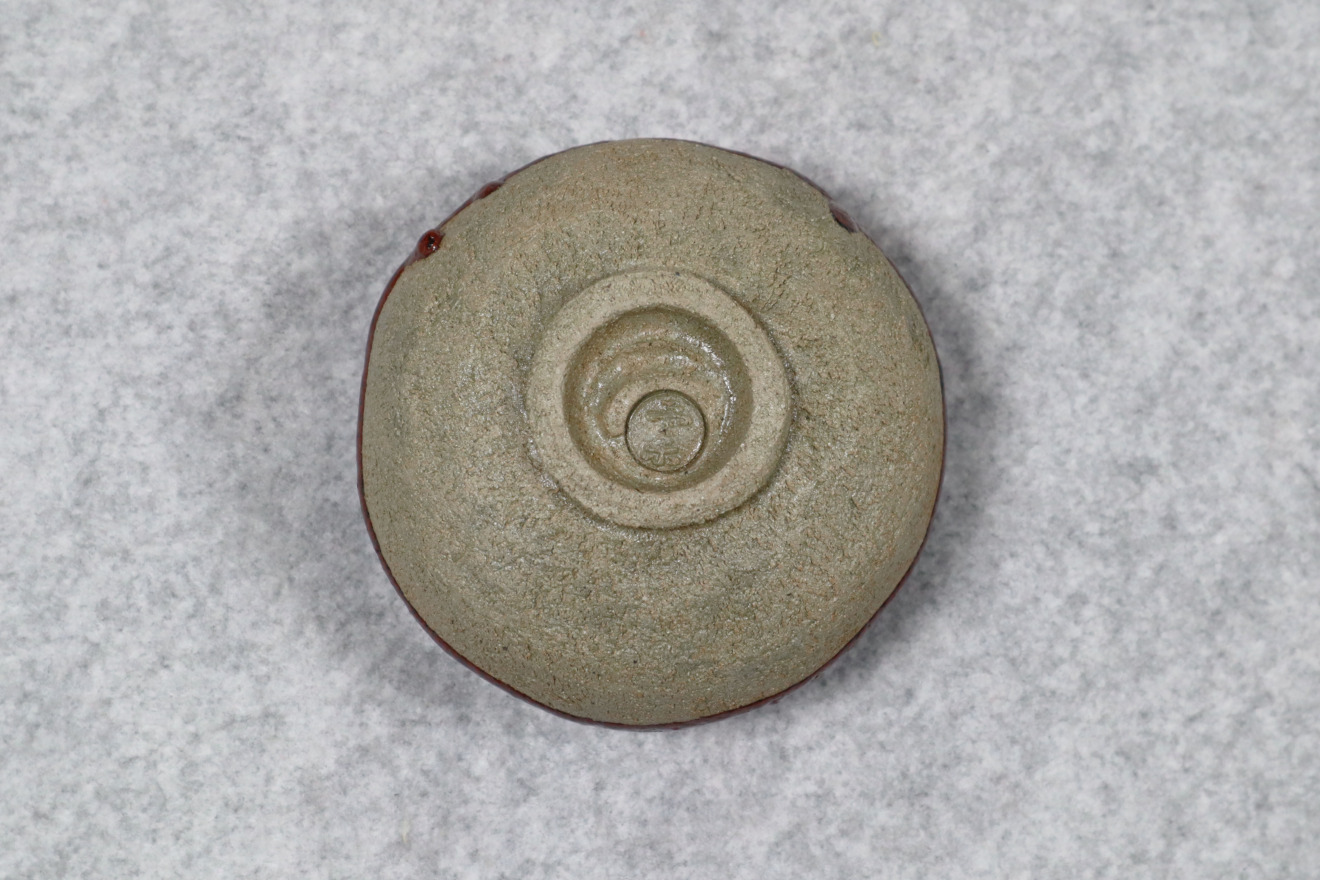


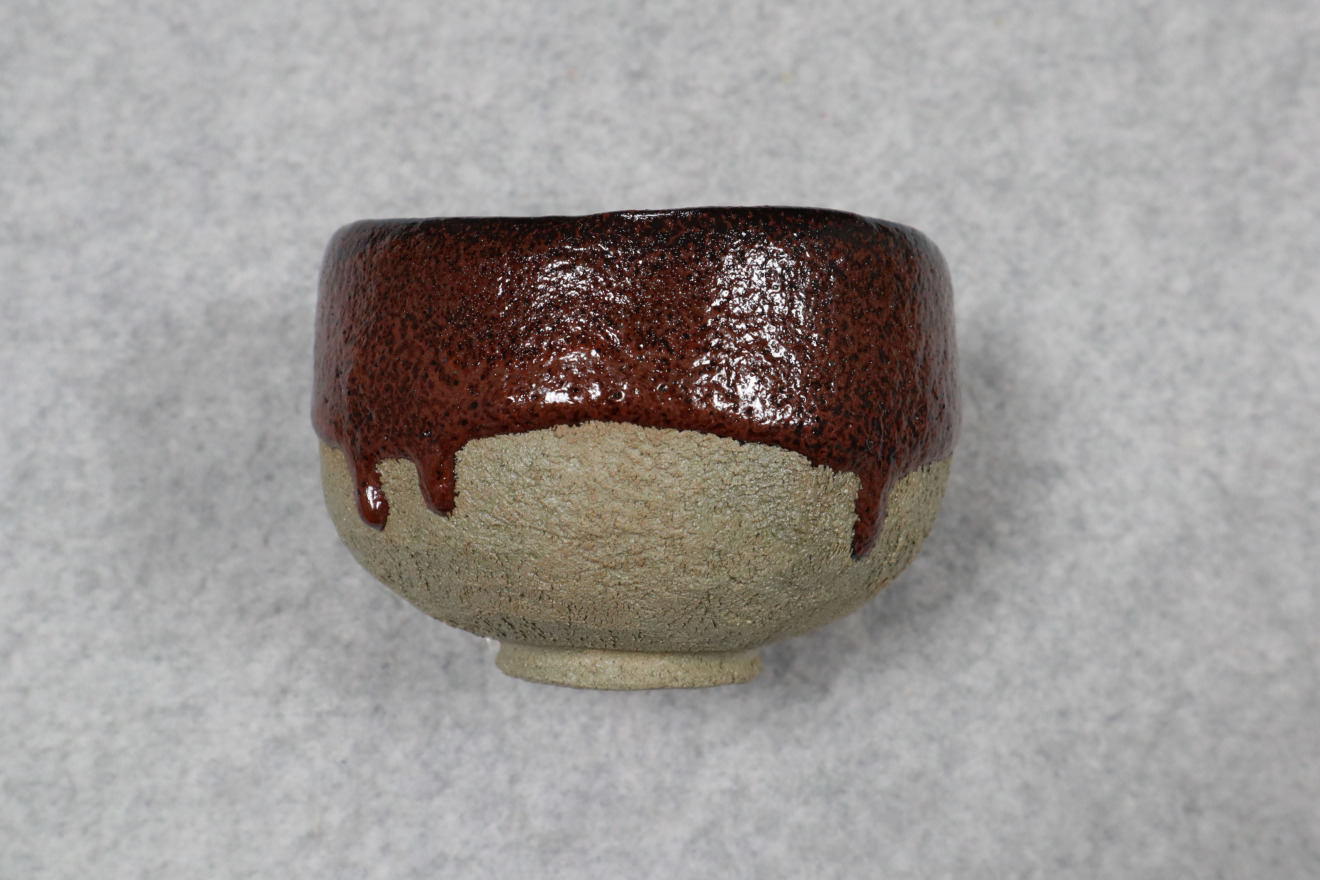

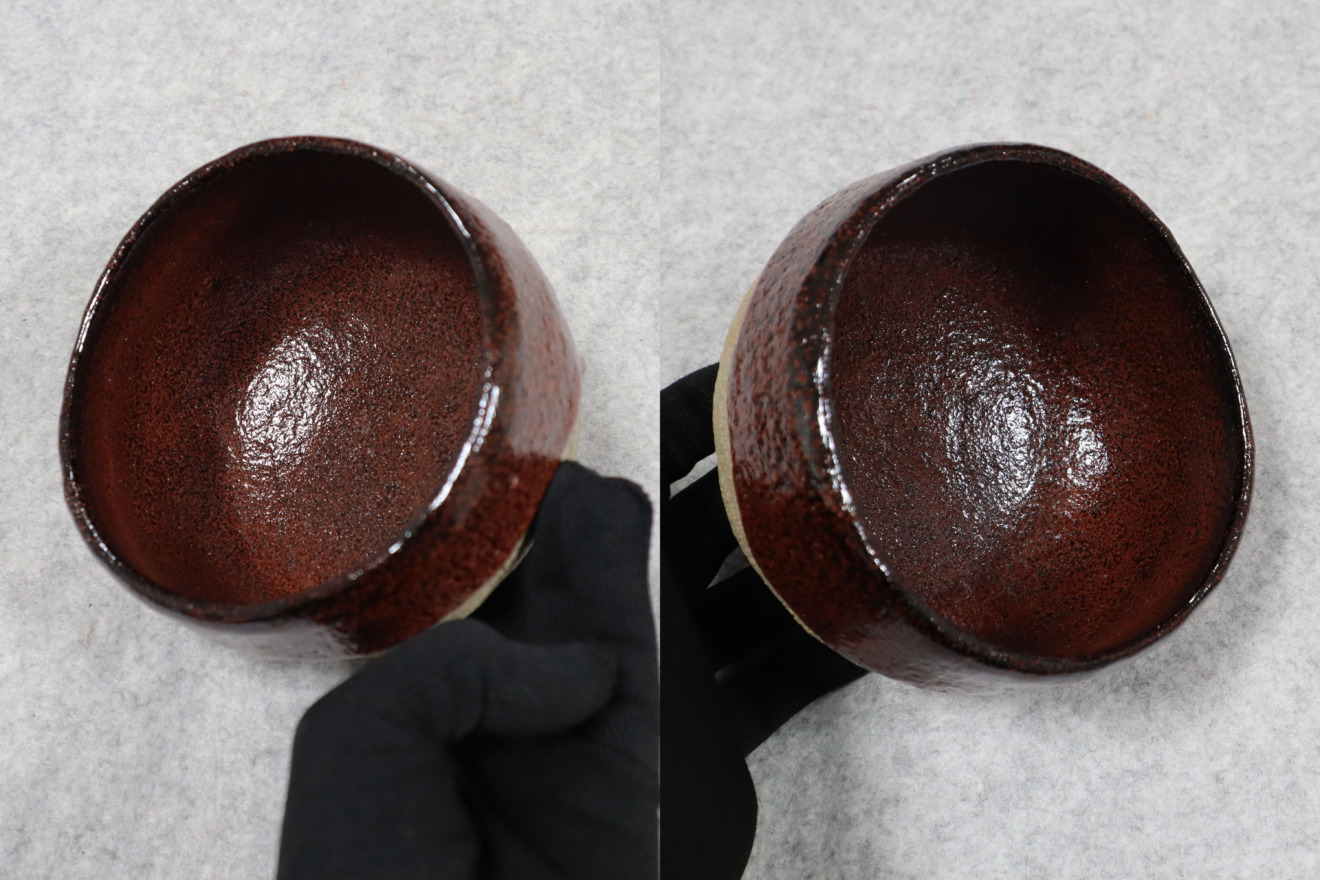


Vintage Black Raku Mei Matcha Tea Bowl, Nishimura Ichiraku, Hoen-kama, Name: Ninnami Utsushi Kuro Raku Chawan, Mei Matcha Tea Bowl, Kuro Raku, Unused,
MB-042201
Raku ware is a type of pottery ware produced in Kyoto.
Raku ware refers to ceramics, mostly tea bowls, produced by the Raku family from the first generation Chojiro. Raku ware is formed by hand, and fired in temperatures from 700℃ to 1,000℃.
There are two type of Raku ware: the Aka-raku (Red Raku ware), which is covered with transparent glaze over a clay surface containing iron oxide, and Kuro-raku (Black Raku ware), which is covered with black glaze. The term “Raku” sometimes refers to all pottery ware made by this same process. – Quote from A Dictionary of Japanese Art Terms
Nishimura Ichiraku born in 1951 in Kyoto as real name is Teruichi Nishimura.
He studied under Naoya Deguchi (1915-1977) in 1973 and started learning the tea ceremony around this time.
After Naoya Deguchi passed away in 1977, he studied under Kyuuko Ohno.
He became independent in 1980.
He lives in Ayabe City, Kyoto Prefecture, and is one of the potters who make high-quality Raku tea bowls.
He specializes in reproduction of Raku tea bowls.
Nishimura Ichiraku is known for his work in creating Raku tea bowls, which are hand-made from earthenware and characterized by low firing temperatures, lead glazes, and the removal of pieces from the kiln while still glowing hot. This traditional Japanese pottery technique is used to create bowls for the Japanese tea ceremony. He owns the Hoen-kama kiln in Kyoto and is recognized as a famous Raku-yaki potter. His works, including the Kuro-raku and Aka-raku tea bowl, are highly valued and often reproduction of Raku tea bowls.
We got it from our friend. It is still in excellent condition with original paulownia box, original cloth and original guide paper. (Unused).
According to our friend, her family did not use the tea bowl.
The product shows no signs of use.
It is an expensive type of Tea Bowl.
The Black Raku Tea Bowl was named “Kuroraku Chawan” by
Ninnami Dōhachi (1783 – July 9, 1855).
Ninnami Dōhachi, born as Mitsutoki, was the second son of the first-generation Takahashi Dōhachi, a potter from Awataguchi, Kyoto. In 1804, when his father passed away, he succeeded to the kiln at the age of 22 and took on the name of the second-generation Takahashi Dōhachi.
He utilized various techniques and styles such as Chinese porcelain-style blue and white ware, colored porcelain, Raku-style black glaze, Kenzan-style (Ogata Kenzan), and Ninsei-style. He was particularly known as a master of “utsushi” (reproduction) of tea utensils.
Ninnami Dōhachi’s works are known for their beauty and practicality as tea utensils. The rims of his tea bowls are shaped and thickened for ease of drinking, the bodies are made thick for excellent heat retention, and the bases are sized for stability, considering the user’s handling.
Kyoto’s tea culture is closely related to the upper class, so Kyo-yaki tea utensils have developed with an emphasis on both splendid decoration and usability.
Ninnami’s works also show designs that consider the hand movements and visual effects when making tea.
Ninnami Black Raku Tea Bowl, The Ninnami Black Raku Tea Bowl has an inscription on the lid of the box written by Ninnami Dōhachi himself, stating “Kōetsu Utsushi (reproduction) Black Tea Bowl.” This suggests that the bowl was modeled after a tea bowl by Hon’ami Kōetsu. However, no tea bowl matching this description by Dōhachi has been found among the known works of Kōetsu. Anyway, the bowl has a round body, undulating rim, and black glaze extending from the interior to the exterior. The black glaze is vividly highlighted by the red glaze, a special technique attributed to Raku. The bowl is a typical work of Dōhachi. In 1865 (Keiō 1), Dōhachi was appointed as Hōkyō by the Prince of Ninna-ji and was called Hōkyō Dōhachi. The inscription “Hōkyō” on the box indicates that this work was created after 1825 (Bunka 8).
Measurement
Diameter: 11cm – 11.3cm / Approx. 4 21/64” – 4 29/64”
Height: 7.76cm – 8.0cm / Approx. 3 1/32″ – 3 5/32”
Thickness: 0.5cm / Approx. 0 13/64”
Weight: 311g
Age: -2010s
Material: Earthenware, Pottery
Color: Black Raku, Suede Blown, Light Khaki
Technique: Black Raku
Title: Ninnami Utsushi Kuro Raku Chawan
Condition: Excellent vintage condition consistent with age. (Unused)
* Original paulownia box (Shihousan, wood nails)
* Original cloth
* No chips, no cracks, no scratches and no blemishes.
* Raku graze dropping on the surface (Refer to No. 9 photo)
* Inscription (Refer to No. 8 Photo)
* Almost no discoloration on the box. (Refer to No. 10 Photo)
* No strange smell.
* You may find “minor scratch” on kodai (the base section of a tea bowl).
*** If you have any questions about the condition or would like additional photos, please contact us before purchasing. ***