


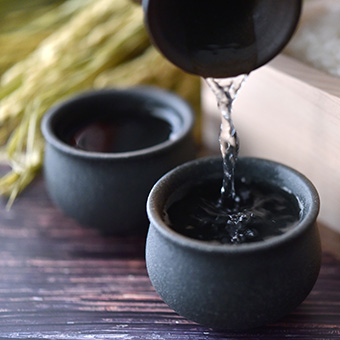


Vintage Glass-Based Glaze Seto Guinomi, Suzuki Seisei, Sake Cup, Choko, Guinomi, Seto Ware,
KC-092302
A ceramic center situated around Seto City in Aichi Prefecture, or Seto ware is produced by the Seto kilns. Following in the wake of the pottery-making tradition of the Sanage kiln, the Seto kiln began producing glazed pottery ware from the end of the Heian Period. The Seto kiln and Mino kiln were the only places where glazed pottery ware was produced in medieval Japan. In Seto, high-quality pieces wares were produced. From the later of half of the Edo period, the Seto kiln produced porcelain ware as well. – Quote from A Dictionary of Japanese Art Terms
The sake cup was produced by Suzuki Seisei (1914 – 1990).
Suzuki Seisei was one of the foremost ceramic artists who, together with Kawamoto Gorō and Katō Shuntō, led the postwar development of Seto ceramics.
Born on May 10, 1914, in Seto City, Aichi Prefecture, to a farming family, Suzuki began working at his aunt’s pottery shop, where he developed a deep fascination with clay and ceramics.
In 1938, he decided to devote himself fully to pottery. Under the mentorship of Katō Kasen, leader of the Shuntō-kai (now the Seto Ceramic Association), Suzuki was first accepted into the Bunten (the Ministry of Education Art Exhibition) in 1940.
He went on to exhibit regularly at the Bunten and Nitten (Japan Fine Arts Exhibition), receiving the Special Selection Award in 1953.
Rooted in traditional Seto techniques such as Setoguro (black Seto ware) and Shino, Suzuki continually pursued innovation and individuality in his work.
In his early years, he experimented with textile-inspired surface patterns, and later developed his own frit glaze, a glass-based glaze that produced luminous and richly colored effects.
His mastery of color and inventive approach earned him the epithet “The Magician of Color.”
His works are characterized by lustrous, flowing glazes and bold, dynamic carving – particularly the forceful ring foot (gokézoko), which imparts a striking sense of energy and presence.
Beyond his creative practice, Suzuki made significant contributions as a juror and councilor for major exhibitions including the Nitten, the Japan Contemporary Crafts Exhibition, the National Ceramic Exhibition, the Chūbi Exhibition, the Kōfū Exhibition, and the Kansai General Art Exhibition.
His lifelong dedication to the advancement of ceramic arts earned him numerous honors, including the Chunichi Cultural Award, the Aichi Prefecture Cultural Merit Award, and the Order of the Rising Sun, Gold Rays with Rosette.
Working in Seto – a region dotted with ancient kiln sites dating from the Kamakura to Muromachi periods – Suzuki found deep fulfillment in creating within this historic landscape.
He described it as “the greatest happiness” to produce ceramics in a land so steeped in history, and aspired throughout his life to create works “worthy of being passed down to future generations.”
His legacy continues to shine as a vital chapter in the modern history of Seto ceramics.
Major Exhibitions and Awards
• Multiple awards at regional exhibitions
• Governor’s Prize, Seto Ceramic Exhibition
• Award, Chubu Craft Exhibition
• Three-time selection, Bunten
• Eight-time selection, Nitten (including one Special Selection; two invitations; three juror appointments)
• Commissioned entry, France Ceramic Exhibition
• Works designated by the Ministry of Education (now MEXT)
• Exhibited at the Museum of Florence, Italy
• Exhibited in the Japan Contemporary Art Invitational Exhibition, United States
• Exhibited at the Metropolitan Museum of Art, New York
• Exhibited in Sweden and Germany
• Exhibited at the World Ceramic Exhibition, Belgium
• Permanent collection, State Museum of Russia
• Juror, National Ceramic Exhibition; Chūbi Exhibition
• Councilor and juror, Kōfū Exhibition
• Juror, Kansai General Art Exhibition
• Juror (three times) and board member, Japan Contemporary Crafts Exhibition
• Juror (six times), Asahi Ceramic Art Exhibition
• Commissioned to produce tableware for the Emperor and Empress of Japan
• Recipient, Chunichi Cultural Award
• Recipient, Aichi Prefecture Cultural Merit Award
• Decorated with the Order of the Rising Sun, Gold Rays with Rosette
The guinomi (sake cup) illustrated here represents a mature example of Suzuki’s art.
The deep tones of his distinctive frit glaze, enhanced by the natural flow of molten glass, reveal his exceptional command of color and material.
The piece achieves a harmonious balance between clay and glaze, embodying both the enduring traditions of Seto ware and Suzuki’s modern sensibility – a refined and powerful expression of his artistic vision.
It is unused in excellent vintage condition consistent with age with original paulownia box, original cloth and original guide paper.
We got it from our friend. She told us to be unused, because her father just collected sake cups as his collection.
We did not see any sign of using on the guinomi.
Measurement
Diameter: 5.3cm – 5.8cm / Approx. 1 31/32” – 2 9/32”
Height: 4.0cm – 4.3cm / Approx. 1 37/64” – 1 11/16”
Thickness: 0.5cm / Approx. 0 13/64”
Weight: 71g
Age: 1973
* Previous owner bought the cup
Material: Pottery
Technique: Seto
Color Surface: Seto Glass-based glaze Lamp Black, Ochre,
Color Clay: Cork
Condition: Excellent vintage condition consistent with age (Unused)
* Original paulownia box
* Original guide paper
* Original cloth
* No chips, no scratches and no blemishes.
* Inscriptions (Refer to No. 9 photo)
* Spots and stains on the cloth due to long-term storage. (Refer to No. 10 photo)
* Wood nails on the box. (Refer to No. 10 photo)
* Discoloration on the box due to sun exposure. (Refer to No. 10 Photo)
* You may find “scratch” on foot (the base section of a guinomi).
*** If you have any questions about the condition or would like additional photos, please contact us before purchasing. ***


