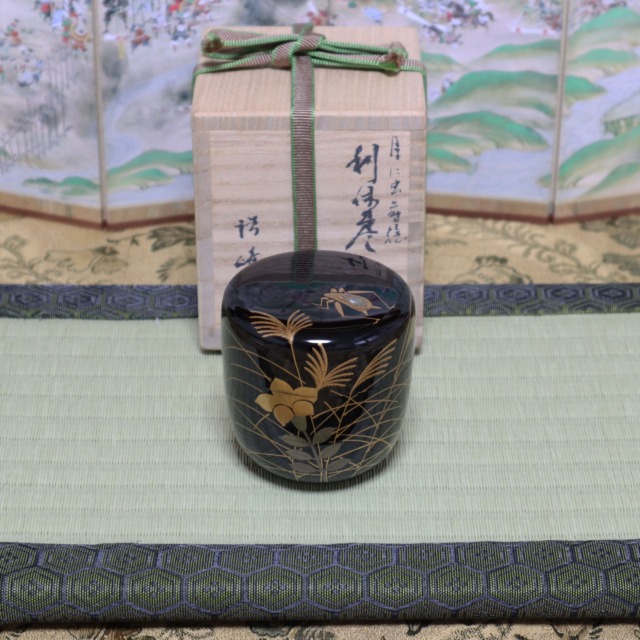


Vintage Unused Natsume Tea Caddy, Lacquer Tea Caddy, Sakashita Yuho, Natural Lacquer, Gold, Makie, Wood, O Natsume, a Design Favored by Hounsai,
This lacquer Natsume tea caddy was made by Sakashita Yuho.
Sakashita Yuho was a maki-e lacquer artist born in 1917 in Yamanaka, Ishikawa Prefecture. In April 1931, he entered the world of maki-e and studied under Sakata Shuho. In 1976, he received the Governor’s Prize at the Maki-e Creative Exhibition, and one of his works was selected for permanent preservation by the town. He was active in the fields of Yamanaka lacquerware and maki-e, and in 1979 he was certified as a Traditional Craftsperson.
This work is a large natsume tea caddy decorated with the “Three Scenic Views” maki-e design, copied after a taste favored by Sen Genshitsu, the 15th-generation Grand Master of the Urasenke school of tea, also known as Hounsai Sosho. Sen Genshitsu was born in Kyoto in 1923 and succeeded as the 15th Grand Master of Urasenke in 1964. Taking the tea name Hounsai, he later transferred the headship to the next generation in 2002 and, as Grand Master Emeritus, devoted himself to the promotion of tea culture and international exchange. He passed away on August 14, 2025, at the age of 102.
The term “Hounsai-gonomi” refers to tea utensils favored by Hounsai Sosho, or those based on his preferred designs and aesthetic sensibility. “Three Scenic Views Maki-e” is an elegant decorative motif based on the Three Scenic Views of Japan: Matsushima, Amanohashidate, and Miyajima.
This natsume is made with a zelkova wood body. The exterior is finished in kijiro lacquer, while the interior is coated in black lacquer. On the body is depicted Matsushima in Mutsu; on the raised inner rim revealed when the lid is removed, Amanohashidate in Tango; and on the underside of the lid, Miyajima in Aki, rendered in gold maki-e and vermilion lacquer. The composition, which places the three celebrated landscapes across the interior and exterior of a single vessel, creates the impression of scenery unfolding as the lid is opened. It combines dignity with a refined sense of play, making it especially suitable for the tea gathering. The design is said to have been favored on the occasion of a tea offering at Itsukushima Shrine on Miyajima and is known as a natsume in the taste of Hounsai.
It comes with its original paper box, Tomonuno (original artist-stamped cloth), an artist-provided leaflet, and Tomobako (original signed paulownia box).
There are no visible signs of use.
Measurement
Diameter: 7.0cm / Approx. 2 3/4”
Opening Diameter: 6.5cm / Approx. 2 9/16”
Body: 7.3cm / Approx. 2 7/8”
Height: 7.0cm / Approx. 2 3/4″
Weight: 47g
Age: -2000s
Material: Natural Lacquer, Wood, Real Gold
Color: Ro, Black, Red, Gold
Shape: O Natsume
Technique: Makie
Pattern: Three Scenic Views in Maki-e, after a Design Favored by Hounsai
Condition: Excellent vintage condition consistent with age. (Unused)
* Tomobako (original signed paulownia box).
* Tomonuno (original artist-stamped cloth).
* Original paper box.
* Artist-provided leaflet
* Inscription on the box
* No scratches or chips.
* Creasing on the Tomonuno (original artist-stamped cloth). (Refer to No. 10 photo)
* Wooden nails on the box. (Refer to No. 10 photo)
* Almost no discoloration on the wooden box. (Refer to No. 10 photo)
* Scratch and light discoloration on the paper box.
If you have any questions about the condition or would like additional photos, please contact us before purchasing.